

Time’s Ellipse by Frasier Armitage
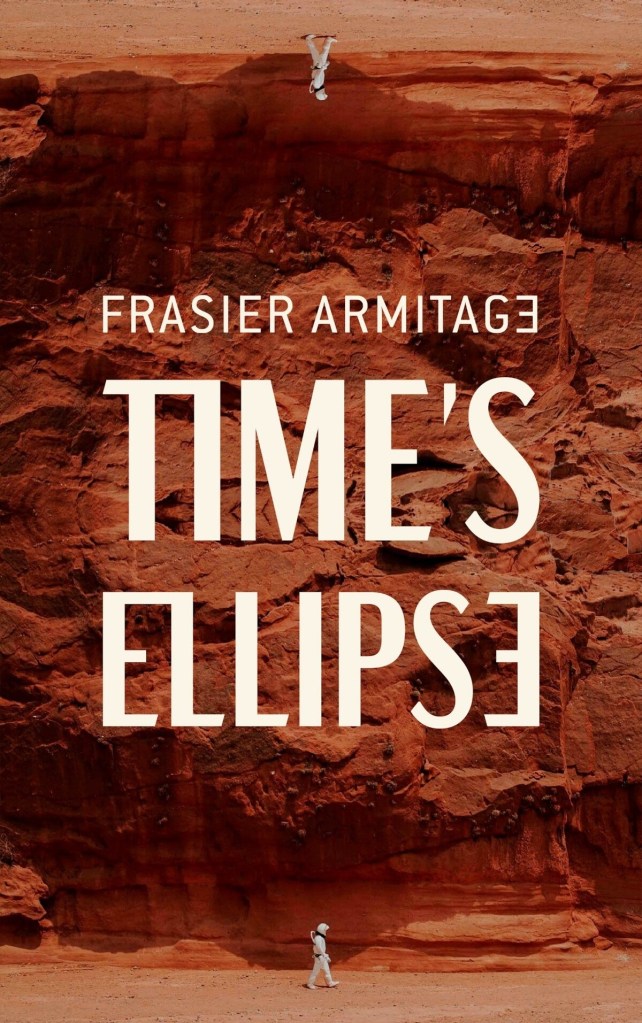
The science fiction novel Time’s Ellipse by Frasier Armitage was released in 2023 and he’s one of those authors I’ve been meaning to read for a long time. I’m glad this book finally rose to the top of my reading pile. This happened to be the first independently published pure sci-fi novel I’ve read, and if Time’s Ellipse is anything to go by the indie sci-fi scene is in rude health. I’m also glad I went into this one without any pre-conceptions as it proved to be full of surprises, making this a memorable read.
When the book begins Doctor Emily Rowlands is facing a difficult decision on a dying Earth as her company, Orbicon, prepares to launch a manned spacecraft into interstellar space for the first time. The central premise for Time’s Ellipse involves a concept called ‘orbital locking’, where the passage of time is affected by the speed of a planet’s orbit around its star. Consequently, with its longer orbit compared to Earth, humans would live about twice as long on Mars with its 687 day orbit. Dr. Rowlands’ dilemma is that on Trappist 1E, the target planet for her spacecraft, Icarus One, it orbits its star every six days. That means for its crew thirty Earth years will pass by in a mere six months. Dr. Rowlands is literally sending her six astronauts to their premature deaths on another world, with no prospect of them returning home.
Now, I must confess that when this was being explained at the start of the story I had some difficulty swallowing this premise. If you’re a reader who enjoys hard sci-fi, with everything grounded in scientific theory, you might find this book a little too fanciful for your tastes. However, before dismissing Time’s Ellipse it’s worth remembering that sci-fi is still speculative fiction and as such it always involves a certain suspension of disbelief. We happily accept ships that can travel faster than light, or nod along when they fold the fabric of the universe with limitless energy to traverse wormholes. And don’t get me started about exciting dogfights involving missiles and lasers, where the loser explodes improbably in the hard vacuum of space.
Why do we accept these things? Because they’re awesome. They’re rooted in the imaginative experience, one which allows us to enjoy an incredible story. The concept of orbital locking is awesome as well, in a more subtle way, because it allows Armitage to explore the profound moral consequences arising from the mission to Trappist 1E and the fate of the human race back on Earth. I can’t really talk about what happens next without spoiling the story, but this is a tale which spans multiple generations and the way it unfolds is only possible because of orbital locking.
Each chapter normally involves a different point of view character. Ceaselessly inventive and surprising, Armitage shows off his storytelling chops with each segment of this novel being completely different to the one before. He uses a variety of storytelling techniques and succeeds in giving each of his characters a distinctive voice. Armitage’s writing is always amusing, engaging and thought provoking. At times I found myself wondering if this was really a short story collection but as the novel unfolds it becomes clear there’s an overarching narrative and the various strands start to come together.
There are times when this story is beautiful and the writing is wonderfully poetic in places. I absolutely loved the wry humour running through the novel as well, which acts as the perfect counterbalance to some of the big concepts and the dire situation Earth finds itself in.
“It’s been said that, in space, no-one can hear you scream. Not true. We’d been in space for a week, and every day, I screamed, and every day, someone told me to pack it in. What would be more accurate is, ‘In space, nobody who screams is very popular.’”
Overall, this novel is hugely ambitious in concept, scale and storytelling. Sometimes it took a faltering step but it always remained compelling reading. It reminded me a lot of the Dark Eden Trilogy by Chris Beckett, which is one of my favourite sci-fi series, so I think fans of those books will thoroughly enjoy this novel. Time’s Ellipse was an emotional and impactful tale, with many moments that genuinely moved me. It’s a great example of how the sci-fi genre allows us to tell stories that couldn’t be told in any other way – providing we suspend disbelief and allow the author to take us on an imaginative journey into the stars.
Review by Tim Hardie



 Spotlight Indie
Leave a comment