
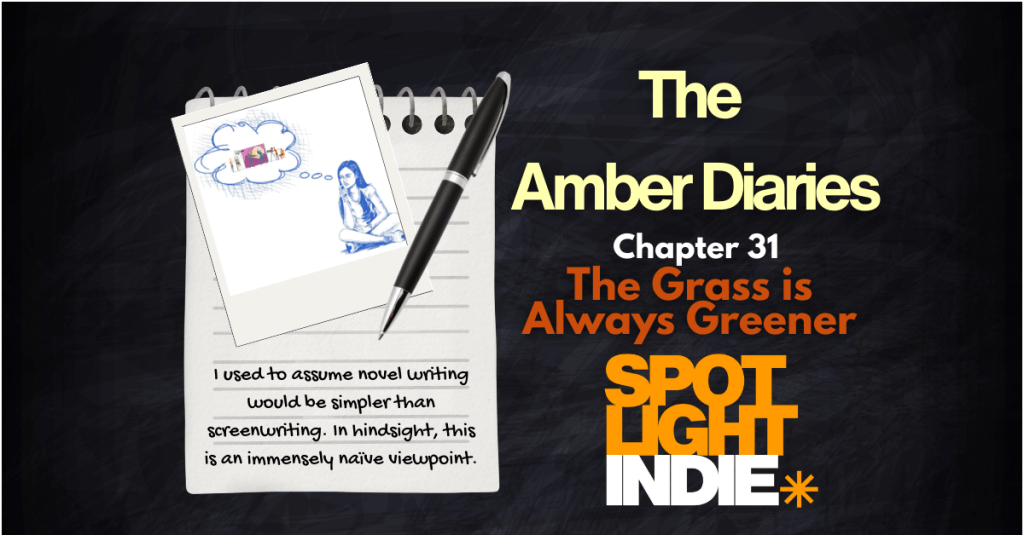
For some reason, I used to assume t hat novel writing would be more straightforward than screenwriting. In hindsight, this is an immensely naïve viewpoint to hold. It’s also one that has most certainly ruffled the feathers or more seasoned writers when I’ve voiced it in the past.
I think my reasoning was that novel writing was more expressive. It allowed storytellers to bring their visions to life in their true form, liberated by a larger canvas resting before you. You could describe and expand to your heart’s content, painting a detailed picture of the world your character occupies. In a screenplay, while you can certainly do this to an extent, you have to regularly remind yourself that you’re essentially producing a blueprint for a production to work from. You can’t go into too much detail about the rooms and worlds, because the set designers and directors will be largely influencing how those settings are ultimately presented.
There was also the option for differing perspectives and approaches that appealed to me in a novel. If you wanted to express what was exactly going through a character’s mind, you could peek into their psychology, provided the narrative point-of-view allowed this. Unless you write in a specific plot mechanic, such as voice over narration or visual depictions, it was a lot harder to examine the inner workings of a lead’s imagination. When you did those things, it often tended to cheapen or make the finished product feel more cliched.
So there I was, thinking that script writing was the hardest thing in the world, whereas novel writing was a method of writing with infinite possibilities. What a doddle it would be!
I was wrong, of curse. Not just a little bit wrong, but monumentally so.
Firstly, all those limitations from screenwriting still very much apply to novel writing. Sure, I can explain the furnishings and materials occupying a room my protagonist finds themselves in, but I can’t just go all out. There’s only so many words a reader will tolerate before deeming a description overly descriptive. I should only explain details that are relevant to the story; otherwise, the narrative slows to a saunter and scenes lose meaning.
Furthermore, the “show don’t tell” rule that often dominates screenwriting 101 also applies to penning books. For instance, if I just sit there and waffle on about my lead’s thoughts, it risks the story becoming lazy and actionless. If my hero is anxious, upset, confused, or fearful, it’s way more effective to demonstrate that through her actions, not by having her perched in a chair, daydreaming about it as though she’s rehearsing for that evening’s diary entry.
I’ve been grappling with these hurdles over the last couple of months, as I work through my first draft, discovering new obstacles of a similar nature on a weekly basis. Perhaps the latest example of this relates to establishing tone and mood.
This is perhaps the most gullible assumption I’ve held to date.
I say this because in a script, a lot of a product’s tone is essentially outsourced to the wider production team. When writing a script, you can certainly pace and describe set that contribute to the feel of a finished product. For a tense thriller, you can write in low, slow-build scenes between characters, locking horns in top-secret bunkers or political offices, but for the wider look of a series of movie, it’s not your job to lay everything out.
This was often something I overlooked when writing screenplays. I’d sit there dreaming up lighting, soundtracks, editing techniques and theme tunes for my various projects. I knew how it sounded, how it looked, and how it felt. Truth is, though, a lot of that stuff wasn’t going to be up to me . It may well have helped influenced how I paced and plotted scenes, but there was no guarantee any of that would make it into a final cut. By that stage, directors, producers, actors, composers, and cinematographers would have had their hands all over the property.
When it comes to novels, you are responsible for the entirety of its execution. Aside from editors and proof readers, if you’re writing a novel, you’re largely going to be in charge of the overall style of your work.
Which is where my naivety kicked in. I figured control would automatically equate to ease. If I can influence what emotions the story evokes, and how it might look in the mind’s eye of my reader, then it’s going to be less difficult to express what my story looks like in my head.
Truth is, it’s harder because I have to do all that with a novel. When I write script, I could just sit there, listening to Synthwave tracks and playing out movie scenes in my head. I didn’t actually have to write it all into my script. It was just a daydream that motivated me to write. When it comes to novel writing, however, if I’m going for a particular tone, I need to make sure that the language, visual style, and prose are remaining true to that vision at all times.
Just because it looks a certain way in my head, doesn’t necessarily mean that’s how it’s going to look in someone else’s. They don’t have access to the same brain as me, so they rely solely on my words to make that happen. The responsibility doesn’t fall on other members of the creative team to do their job too. It’s all on me to make sure all the right cogs are turning; otherwise, a significant bulk of the story isn’t communicated.
At the time of writing this, I’ve realised that this is a hurdle I haven’t figured out how to overcome. I know full well what my story looks like in my head. I can see all the futuristic vistas, the music that plays as Michelle and Quinn roam the night time woodlands, and the unique glow of the late 21st century London Skyline. But capturing all of that entirely in prose right now just feels so difficult. It’s like being asked to spin a plate whilst folding laundry. It’s too complex a task to do alongside another task.
I sense this is a trick that will come to me the more I write. Furthermore, t he fact I’m still working on the first draft suggests I’m not yet in a place where I need to worry too much about these factors. I’m still in the process of getting my story out onto the page. The finger details and vision will surely come alive as drafts two and three are produced.
Be that as it may, the responsibility fills me with dread. In the olden days, thinking about the final product was more of a fanciful daydream; a hope that I’d get a good production team behind my work who could help bring my vision to life. Now I’m migrating to novel writing, I’ve come to the realisation that I am the production company, so to speak. I’m in charge of the so-called soundtrack, lighting, mise-en-scène and camera work. There are no filmmakers or actors working alongside the blueprint of my novel. It’s all on me.
That’ll teach me for assuming the grass is always greener on the other side.

 Spotlight Indie
Leave a comment