
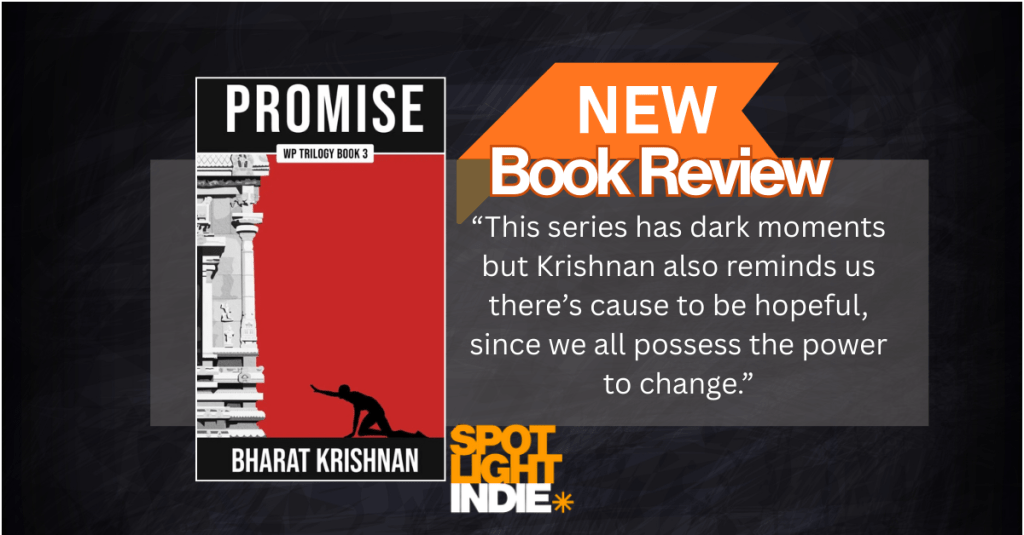
Promise by Bharat Krishnan
Promise concludes Bharat Krishnan’s WP Trilogy. All three books came out in rapid succession at the end of 2020. My first thought when I reflected after finishing the series was that Krishnan might have benefitted from taking a little bit more of a breath between each publication, just to allow him time to give each story a final polish. That said, I understand why he went with rapid release. Since this is primarily a work of US political satire (albeit one which takes place in an alternate version of history) there’s always a risk that with the passage of time the story begins to lose its relevance as real world events move on. The fact that five years on the issues he tackles remain, if anything, more relevant than ever is something we should all pause and think about.
Politics has, of course, been very prominent throughout the series but it becomes the primary focus of the third and final book.
Tim Hardie
The plot of Privilege was built around a heist story, Power featured romance and in Promise we get a political thriller. Politics has, of course, been very prominent throughout the series but it becomes the primary focus of the third and final book. As a brief reminder, the central premise of this trilogy is a drug called WP was discovered during the 1800s which essentially grants users superpowers. WP can increase your strength and agility, heighten your senses and help you recover more quickly from injury. It also has the power to change someone else’s memories and even their perception of reality. The powerful drug is only legally available to Caucasians, and the pros and cons of legalising its use by other ethnic groups has been a central debate throughout the series.
Under the administration of President Brooks, US Defense Secretary Kaitlin Lungford is waging war on other countries to seize their WP whilst trying to emerge from the shadow of her loathsome uncle, Senator Charles Lungford. As a result, Rakshan and his friends find themselves fighting a proxy war in Guatemala, operating as a unit of special soldiers who use the WP drug to enhance their fighting abilities. This is a far cry from the hedonistic lifestyle Rakshan previously craved and felt he deserved when the series began.
The story itself is set in 2021 and the US is holding elections which will determine various key political appointments as well as whether President Brooks can win a second term. His main rival is Senator Begaye, who is trying to become the country’s first Native American president. With the political blocking of the legalisation of WP in the previous book, this remains a contentious issue which divides the candidates on the campaign trail.
Having worked in professional politics for ten years, Krishnan clearly understands the long-term underlying issues which affect US politics today. The best parts of the novel are when he’s exploring the brutal way the election is fought behind the scenes. Begaye apart, this is a ruthless struggle between various politicians, reporters, fundraisers and the wider family members of the political elite. It’s a cutthroat, grubby business and as you would expect various characters do appalling things to each other to try and gain an advantage over their opponents.
Against this backdrop, Sadiya’s life is on hold, unable to marry Maadhini as her parents have had their visa application to travel from India to the US denied. Even worse, one of Maadhini’s old flames is back on the scene, looking to cause mischief. The insights into Indian US life provide a welcome contrast to the various machinations of the political thriller storyline. It gives Krishnan a chance to showcase the range of his writing. These scenes are infused with plenty of humour and warmth, especially their larger-than-life wider family members, who mean well but always manage to say and do the wrong thing. Sadiya and Maadhini’s chapters were my favourite parts of this novel (as was the case with the previous book) and I think they’re fantastic characters.
Sadiya’s ex, Rakshan, is fighting in Guatemala as he sees this providing him with a way to put things right with her, whilst his victim from the first book, Aditya, works towards Rakshan’s downfall in order to exact his revenge. Whilst I enjoyed this angle, which is very different from the first two books, I wasn’t as keen on the various action scenes in South America, which involved troops and criminal gangs both using WP to enhance their combat abilities. I just didn’t find them that gripping, and instead I tended to be looking forward to returning to US politics or the slice of life aspects of Sadiya and Maadhini’s story instead.
As a reader, I think how you will respond to this series is very much down to your personal and, frankly, political tastes. Krishnan took a big risk since the whole trilogy is a massive genre fusion – alternate history, political thriller, heist, romance, the criminal underground, police corruption, warfare and comic book superhero elements all find space on the pages at different points in the plot. I think he has to be commended for the fact all of this works so well. However, in a novel with such a wide range of influences there are bound to be some aspects which work better than others for particular readers, and this was the case for me.
The whirlwind effect on the reader of all these different ideas is also partly down to Promise being such a short book (in fact, all of them are), and Krishnan is left with a lot of plot arcs to develop and ultimately conclude in this instalment. Krishnan pulls everything together really well in a small number of pages, especially in the final quarter. This certainly isn’t a case where everything is left on a cliffhanger (as was the case in the previous book) and I was pleased we get a satisfying, if unexpected, resolution to a memorable story.
Overall, I loved how Promise and the rest of the WP Trilogy books are so different from anything else I have read. Krishnan asks some really important questions throughout the series and the light he shines on the US and, by extension, Western culture is uncomfortable at times. This series has dark moments but Krishnan also reminds us there’s cause to be hopeful, since we all possess the power to change. How will we choose to use it? Well, that’s up to each and every one of us.
Review by Tim Hardie



 Spotlight Indie
Leave a comment