
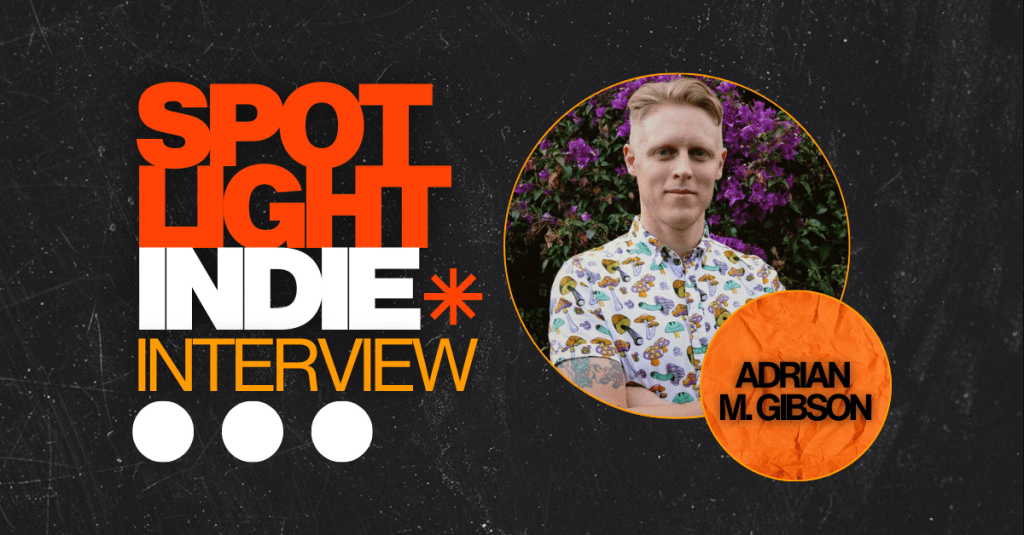
Growing up in the mountains of British Columbia, Ontario-born Adrian M. Gibson spent many years working in a number of creative fields, ranging from music journalism to tattoo artistry, before finally finding a home in the world of the written word.
“Writing stories was what I always wanted to do, ever since I was a kid and fell in love with books and reading,” Adrian tells us.
His venture into writing arrived at a turbulent time, both personally and globally. 2020 saw the rise of a pandemic which pushed the world indoors.
“It wasn’t until the COVID pandemic – when I had to close down my tattoo shop and my wife was pregnant with our first son – that I recognised an ideal opportunity to get involved in the SFF community and start writing fiction more seriously.”
Such a moment propelled Adrian into novel writing, allowing him to pursue a dream rooted in his childhood.
“A lot of my younger years were spent reading and drawing. I filled binders of looseleaf paper with illustrations of warrior animals and landscapes and tasty confections.”
Considering Adrian is someone with a flair for the visual as well as the written word, did these two seemingly separate artistic tendencies play a hand-in-hand role when it comes to his novel-writing workflow?
“Very much so! Part of my worldbuilding process always involves sketching and illustrating, whether that’s character portraits, locations, architecture, food, etc.,” he confirms. “I’m a highly visual person, so the things that I’m imagining in my head really come to life and cement themselves when I allow that idea-to-illustration workflow to occur.”
As well as helping to kickstart the ideas occupying his mind, drafting out the optics allows Adrian to develop a more grounded and pragmatic dimension of his concepts.
“This visual thinking is also crucial for my sense of space in any given scene so as to better understand who and what are where… For this, I’ll usually draw maps and blueprints, thinking through the layout and understanding paths, obstacles, etc. in relation to where the characters are, where they need to go and what is in the way of them reaching that objective.”
Blending graphics and illustrations into his books furthermore allows Adrian to include an “extra layer of immersion” for his audience.
“I inherently believe books should be an experience,” he tells us. “Including visuals into the book itself can give readers a deeper sense of connection to the stories that they’re reading. (It’s why so many people love special editions, right?)”
Art and storytelling have been a part of Adrian’s life from an early age, but which stories inspired him the most during those younger years? While he cites classics such as Tolkien’s The Hobbit, it was the Redwall series by Brian Jacques that truly influenced his worldbuilding desires.
“Something about the adventures of those anthropomorphic animals completely enthralled me,” he explains. “From the battles they fought and the elaborate meals they ate to the interpersonal relationships and stakes both personal and grand. Jacques captured my imagination in a way that few other authors had.”
And what an imagination he wields. Ever since diving into his lifelong passion, Adrian has given rise to a unique subgenre coined fungalpunk noir. His 2024 debut, Mushroom Blues, as well as his work on the new The Book of Spores anthology, showcases a self-proclaimed “not-so-casual obsession” with one of nature’s many astounding peculiarities: mushrooms.
“I love how strange fungi are – the way they look, smell, feel, taste, touch. How they take on such bizarre, alien forms, and how they interact with our world in a truly unique way,” he tells us. “Fungi are a full sensory experience, in every way.”
There’s a depth and enigma to the biology of mushrooms which inspires and captivates Adrian’s imagination. A mystery which makes them fertile for storytelling.
“We know so much about the surface of our moon and Mars, for example, but there are still grand mysteries out there, including the depths of the oceans or what lies deep beneath the soils of our continents. And the latter is where most of the world’s fungi exist, as mycelial networks that spread farther than we could ever imagine. So it makes sense to combine the mysterious with the fantastical, taking what we already know about the mushroom kingdom but twisting those facts and extrapolating them in fascinating ways that fuel (and sustain) the narrative vehicle.”
From such a fascination grew the alluring mutation of a subgenre inspired by the cyberpunk genre. “In my mind, fungalpunk’s core mantra is ‘how can fungi transform the world?’” he explains. “It boils down to this concept of ‘high tech, low life’ where you explore the stratigraphy of society.”
Adrian’s exploration isn’t simply restricted to the societal. The subgenre is also concerned with the biological makeup of his fictional world’s inhabitants, something which he delves into in Mushroom Blues.
“The fungal people that I created are a representation of how fungi might symbiotically merge with humans, changing us in ways that alter how we communicate and think, how we organize society, the environments we live in and so much more (not to mention our very biology).”
Such a symbiotic marriage between the fungal and the flesh allows Adrian’s novel to examine deeper existential questions lying at the heart of the human experience.
“It’s really digging into fundamental concerns of the human experience and exploring those concerns from different angles and through a variety of perspectives. From questions of bodily control/autonomy to alternative modes of networking/connection, or reimagining organisational structures of institutions like governments and religions, or delving into unconventional philosophies about the universe and the afterlife – it’s about transformation, and confronting the strangeness or discomfort that transformation often entails. And this is all so fitting because fungi are nature’s recyclers. These organisms straddle the line between life and death, where consumption and destruction give rise to creation and rebirth. Hence, transformation.”
This fungi-shaped fascination also fuels Adrian’s latest project, The Book of Spores, an anthology he’s co-edited with Frasier Armitage, Eleni Argyró and Ed Crocker. Though seemingly a logical continuation of Mushroom Blues, The Book of Spores was very much the product of a collective decision.
“The most incredible thing is that the theme itself, being centred around mushrooms, came down to a group vote. Out of the three themes and topics that we’d come up with, fungi won the day.”
Anthologies of this nature often have multiple voices at the heart of them. Seeing a project of this scale reach completion requires a high level of collaboration and communication. How did Adrian’s team steer this project to its intended destination?
“I’ll give a lot of the credit to Frasier Armitage for taking on the heaviest load during the early editing process. The stories were gathered slowly, as we were quite lenient with deadlines.”
Though the project carried a flexible timeframe, there was an anchor given to its authors that threaded each fable together. The titular Book of Spores was designed to traverse a fictional multiverse, allowing a collection of unique styles and narratives to connect.
“The prompt was that each story would be a world that the book is infecting, but the genre and how the book played into the story was entirely up to the authors. As a result, the authors had a ton of fun, and each of them created an incredible, unique world.”
Curating a collection of stories is a much different challenge to solo writing. Adrian admits to often involving friends, family and fellow creative artists in the process when writing, which made the jump to a collaborative anthology much smoother than it might have been for a more solitary artist.
“The cool thing about anthologies is that you get to peek into other writers’ minds and worlds, seeing how they work and how their ideas/voice make it onto the page,” he shares.
“An anthology is fundamentally about gathering an array of voices and organizing them in a harmonious way. I recently likened this dynamic to a choir or a symphony, where you are pinpointing distinct people with distinct talents and figuring out how to best arrange them, such that they produce the most beautiful and synchronistic result.”
In addition to his writing contributions, Adrian is the founder and co-host of the SFF Addicts podcast, which he hosts with M.J. Kuhn and Greta Kelly. We were curious whether dissecting the craft alongside fellow authors has influenced Adrian’s approach to his own writing.
“The entire reason I started SFF Addicts was to learn from authors and absorb as much as I could from their expertise,” he confirms. “A great deal of who I am as a writer is owed to all of the authors I’ve interviewed over the years.”
Beyond writing the adventures engineered by his mind, Adrian resides in Quito, Ecuador with his wife and sons. He can often be found cooking, playing video games, and exploring nature.

 Spotlight Indie
Leave a comment