
“He had never had much in the way of good fortune. It didn’t matter now. He would have liked to have said that he had no regrets, but it would have been a lie. He had plenty of those.”
We Men of Ash and Shadow
When I started writing my first novel, We Men of Ash and Shadow (back in the good old days when the world felt young, influencers weren’t a thing and nobody knew what the word yeet meant), I invested a significant amount of time into research.
Well, that’s what good writers do, you might be thinking. And you’d be correct. But in this case, the thing I was researching had nothing to do with the book, other than a general thematic connection. It was instead fuelled entirely by my rabid curiosity about brains.
There are certain elements of my writing that deal with (or at the very least are inspired by and have their roots in) unusual psychological phenomena. The strange habits and functions of our mind, which range from the mildly odd to ‘I don’t know, Tinsley, that sounds like bullshit to me’.
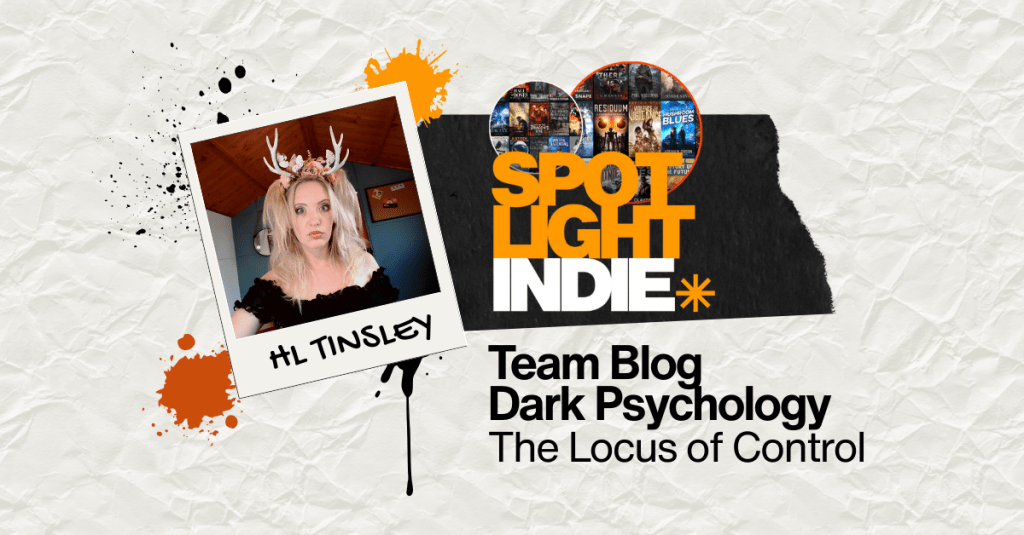
The articles I’ll be sharing here over the next few weeks are from a series I wrote for my website called ‘Dark Psychology’ back in around 2018. I hope they provide some inspiration or feed into your writing in some way. They have since been updated, but are still, I believe quite interesting.
Your Internal Locus
Picture it. You’ve just bagged a big promotion at work. You’ve finally managed to work out what’s been making the clunking noise in the attic at night. You’ve gotten twenty out of twenty on the ‘How Many Types Of Cheese Can You Name’ quiz that popped up on your phone. You’re on top of the world, nothing’s gonna stop you now and everything is coming up [Your Name Here].
But who do you have to thank for all your recent success? If your answer is ‘me’, chances are you have an internal locus. On the other hand, if you attribute your triumphs to fate or luck, you’re more likely to be working with an external locus.
When I first heard the term ‘Locus of Control’ it conjured up images of some great, omnipotent Acrididae flying through space, wiggling its intergalactic antennae. Anyone else? No? Just me.
The ‘Locus of Control’ is the concept of an individual attributing the causes of their successes or failures to a specific factor. And while it’s not necessarily a phenomenon, it’s not a generally well known concept. Essentially, there are two types of loci – internal and external. Studies suggest that people who have an ‘internal locus’ are more likely to credit themselves for their achievements, i.e. this is the product of own hard work. Whereas those who have an ‘external locus’ often believe that success and failures are caused by ‘fate’ or the universe. I.e. I got lucky.
There are pros and cons to both sides of the locus coin. When we think of our characters, we probably don’t consider what sort of locus they might have. But, if you were to go back through your favourite books right now, I guarantee you’d be able to see which category each of the characters fall into. And it’s something worth considering when writing.
There are pros and cons to both sides of the locus coin
For example, while some argue that being either an ‘internal’ or ‘external’ locus type is something intrinsic, others believe that childhood experiences are pivotal in influencing this aspect of our psyche. Studies have been done that suggest people who were encouraged to think and act independently – and who were introduced to cause and effect whilst in the cognitive development stages – were far more likely to develop the internal locus.
It can be helpful to take this into account when developing or ‘padding out’ a character, especially if they are likely to encounter a successive streak of failures or successes over the course of their arc. Of course, it isn’t always as simple as someone fitting into either one category or the other. Being an internal type doesn’t mean your character won’t occasionally hurl their fist skyward and curse the name of the gods. Just like being an external type doesn’t mean they won’t ever feel any sense of personal accomplishment.
And then, there’s your own internal locus. Your writer locus, if you will. That one can be harder to control. The goal is to find what is called the ‘flexible’ locus. The one that can pivot from internal to external as and when you need it. The one that reminds you that whatever success you’ve had can be attributed to a combination of hard work, talent and luck. Of course, if you are looking for someone to blame when things go wrong, you could always just imagine a giant grasshopper hurtling through the universe. Chances are, it’s all their fault anyway.
You can find We Men of Ash and Shadow, my gaslamp grimdark low fantasy here.




 Spotlight Indie
Leave a comment