
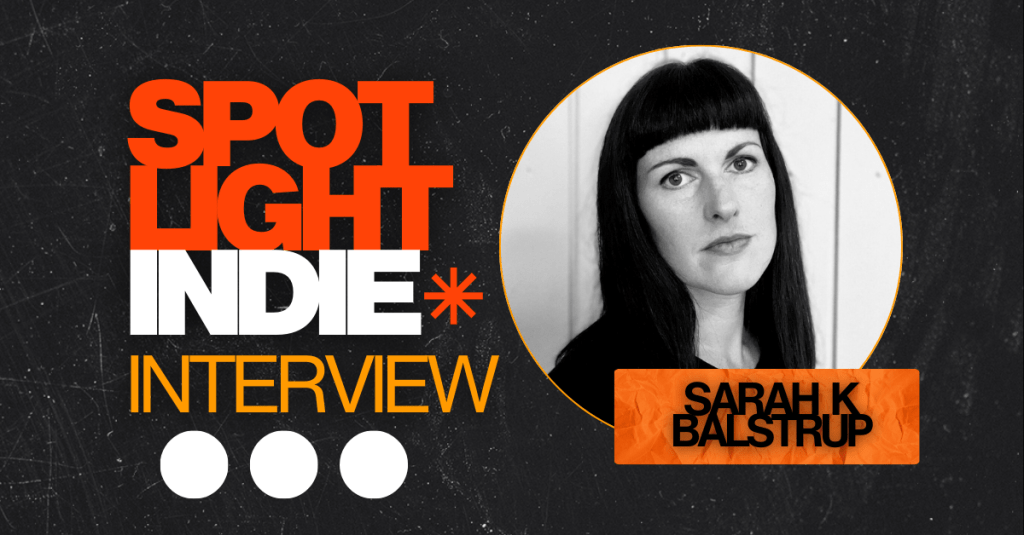
Hi Sarah, tell us about your most recent release or an upcoming release:
My most recent release is Black Stream, the sequel to The Way of Unity.
The Way of Unity explored the tragic aftermath of a religious schism, showing what happens once you do the extreme thing that you think will solve the problems of society. It takes the view that humanity exists as a single organism and that our collective shadow cannot be so easily stamped out.
Each action prompts a reaction, and Black Stream sees the extremes of The Way of Unity reversed in a burgeoning religious revival. As history shows, we can never go back to the way things were, and each advance brings with it the experience of what passed before. It is a slightly darker story than the first but a little more accessible in style. I’m really proud of this book and hope that it can find a wider readership.
Who was the first author that you remember reading?
I read a lot of junk as a kid and these first stories had less of an impression on me than my first favourite movies: The Neverending Story, Mary Poppins, The Labyrinth, Willy Wonka and the Chocolate Factory etc.
I enjoyed the books I studied at school but it was not until I stumbled across Virginia Woolf’s Orlando when I was 17 that I truly felt a spark of excitement for reading. That book is infused with so many of the things I love in writing: romantic tone, eccentricity, deep psychological emotion, wit, and experimental deftness. It was the first book that felt like ‘art’ to me, and it sat in the back of my mind as a place holder for many years, reminding me what writing could be.
What was your original perception of indie writing and how has that changed?
Before I discovered the self-published sff community on Twitter, I associated self-publishing with poor quality writing and cover design based on the few self-published retiree memoirs I’d come across. I was absolutely blown away by the quality of self-published works once I started to follow authors working in this sphere.
I realised that self-publishing is the place for two things I love:
- Creative projects that don’t fit the mould – those experimental, deeply personal and unique creations that demand to exist, whether or not the mainstream approves.
- Entrepreneurial creators – It’s like when you discover a new café that hits every note – the staff are friendly, the coffee is great, the food, the music, the décor – everything about the place buzzes with personal passion. Some of the more popular indie authors are like this. They are true entrepreneurs and you can feel the energy in their work. Because successful self-pub authors give so much, their readers are more committed, and there is a genuine sense of community.
Which authors have most contributed to or influenced your indie experience?
Some for their writing, some for their generosity and support, some for their style:
Yuval Kordov, Philip Chase, P. L. Stuart, Tom Mock, Daniel Maidman, Joseph Sale, Steven William Hannah, E. L. Lyons, Adrian Gibson and Palmer Pickering to name a few.
What practices, rules or disciplines do you set yourself when it comes to writing?
Overall, I try to keep the windows of my mind open to creative insight at all stages of the process.
In the beginning, I use tools like tarot cards to consider and test different types of story arcs and character interactions. If something doesn’t feel right, I select random passages from books or songs and apply them to my outline, looking for symbolic connections and patterns that stand out to me.
I lay out chapter concepts in a loose outline and write chronologically. Every 40K words or so, I stop writing and complete a full editorial sweep where I identify world building inconsistencies and logical contradictions. With a long list of questions to answer, I take off my editor’s hat and go back into creative mode. Where the story had split in weird directions, I stand back and consider whether these errors are actually better ideas than what I started with. Usually, I am decisive with my cuts and happy to shift to the better idea but sometimes things are hopelessly tangled. When this happens, I meditate on the question and if I am suitably immersed in my writing (i.e. writing daily with obsession activated), the answer will come to me with striking clarity within a couple of days.
Sometimes, explaining the problem can bring about a solution. Other times, the answer comes from the books I am reading at the time. There are answers everywhere if you pay attention and seek them out.
At some point, when the word count has grown, I get the feeling that the story has all its ingredients and needs nothing new. I kill a lot of darlings in the final stage of editing.
When the manuscript goes to my editor, I keep my head out of it for a full six weeks so I can see the story afresh when it comes back to me. During this time, I paint and design the book cover and think about marketing. Then, when the MS returns, there are corrections, reconsiderations, and a full listening edit.
The final ‘it will be what it will be’ phase kicks in and it is time to hit the ‘upload’ button, the ‘publish’ button, and in all the wonder and joy of completing a novel, the focus shifts to readers, reviews, social media posts, and it feels a bit sad not to be working in the vast fields of imagination…
What’s a myth about the writing process you’d like to dispel?
In self-publishing, authors torture themselves by creating arbitrary deadlines based on the feeling that if they don’t publish frequently, then their readers–and the algorithm–will forget them. The speed of print-on-demand publishing is one of the advantages that self-published authors have over the slow beast of traditional publishing. Still, output should not be the primary driving factor for creatives if they want to produce work of meaning and longevity.
In reality, there is no deadline, and no need to constantly perform (even though it feels like there is).
There is a huge shift, these days, towards live content. I see it in my feed on a daily basis. Authors on Instagram film themselves writing, they share weekly updates about the writing process, and release chapters as they are written. Books seem to be written on a conveyer belt with the spotlight shining all the while. The world is invited backstage to watch each efficient step, from idea, to the final moment of tearful unboxing. The likes roll in, there is engagement, but when does the author take a moment to deeply reflect on what they are producing?
In reality, there is no deadline, and no need to constantly perform (even though it feels like there is). My advice for writers is to step off the carousel. Slow down. Sit with your story long enough so you can deeply reflect on it. Not as a critic or an editor, but as an open mind, full of patience and curiosity. There is a deeper layer to writing that is the author’s gift to access and when this layer is perceived, it can be subtly shaped. The story you have written can become fully realised, and you, the author, can gain fundamental insights into yourself, and your place in the world, through this story that you have written.
I’m not a huge Stephen King fan but in his book On Writing, he gives the following sage advice: “write with the door closed, rewrite with the door open.” Writers owe themselves the privacy and freedom to explore ideas before the light of public scrutiny shines upon them. Why do we read fiction at all? We read to imbibe the compressed energy that the writer has infused in their work. The hours and years of deep reflection, reconsideration, and refinement–all that time that has been spent–should find itself distilled in the final creation. My taste is for cask strength fiction, but light-hearted page turners can also be deeply affecting and finely crafted. If it took a year to write the manuscript, don’t waste that year by rushing to publish it. Take an extra three months. With TBRs being what they are, no one will notice. Believe in your story and give it the time it needs. You will not fade into oblivion.
What should people expect from your books?
I write dark literary fantasy and am strongly drawn to themes of spiritual crisis and transcendence. I approach religious themes with an emphasis on religious experiences, where belief is not a given. My worldbuilding can be considered ‘religion building’ as it is in the religious threads that I incorporate most of the symbolic and thematic elements of the story.
The Velspar Elegies series takes place in an epic setting but is primarily focused on inner experience. Struggles take place within the psyche rather than on the battlefield and I would say that the series, overall, is about coming to terms with death and the unknowable.
My love of music and poetry comes through in the prose and the mood of these stories is melancholy, surreal, tragic, but ultimately hopeful.
What have you got coming up or what are you working on?
After publishing Book 2 in the Velspar Elegies series, Black Stream, the themes and storyline have dovetailed. My planned third book, and series conclusion (A Trail of Stars) was half written before I realised that I could not reach the end without answering some fundamental questions about religious origins. With A Trail of Stars on pause, I am currently working on a prequel that explores the life and times of Skalen Karasek, the eponymous founder of Velspar’s religion. The prequel is growing slightly larger than intended but the story takes me where it wants to go.
 Spotlight Indie
Leave a comment