
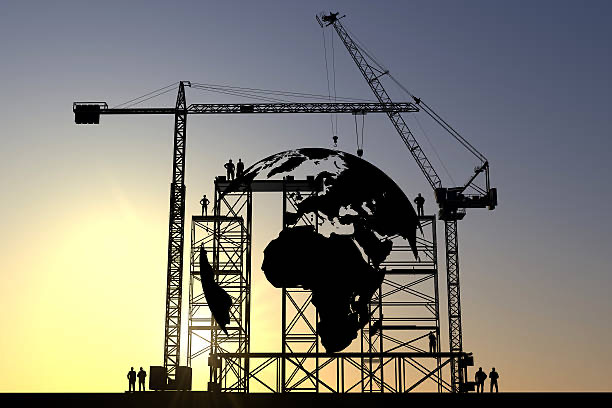
I’ve become slightly obsessed with the hypothetical, future Britain serving as the backdrop to my novel. In the weeks leading up to starting my opening chapter, it was all I thought about. I’d daydream about the countless societal and historical shifts that led to the authoritarian Albion Crown party weaving themselves into the British electoral system, tearing apart the country’s democratic structure over the course of many years. I imagined the numerous legal, cultural, political and economic shifts that would gradually reshaped the once-hopeful Britain of tomorrow into a hellscape. I wanted to know it all; every detail and moment that gave brith to the world Synthetic Empires was set within.
So many ideas bounced around my head, to the point where I figured I needed to get them all down on paper. This is why I started working on a Wiki entry for this interpretation of Britain’s tomorrow. I planned to chronicle all the key players, the historical turning points, the protests, the backlash, and the gradual introduction of the draconian rules which would lock the nation’s people into a state of submission.
My reasons for this Wiki entry was down to the fact I was trying to make sense of this world as best I could, reasoning that the more I knew, the more confident I would be when it came to penning each chapter. Yet the more I fleshed out this Wiki entry into my project folder, the more I began to question my actions. Was this the right thing to do?
I suppose the answer isn’t a clear-cut yes or no. World-building is an immensely personal process which differs from writer to writer. It’s true that some stories and authors flourish more than others with this particular activity. For instance, if you’re writing a series of short stories or novels set in a particular universe, a coherent timeline can make it much easier to establish a robust continuity. The depth and flow of events can provide an author with a roadmap to use as they guide themselves forward through the many stories allocated to that fictional vista. Furthermore, such depth can serve as a hub of ideas, with new stories springing from the many conflicts and political developments. Under these circumstances, the backstory gives rise to the primary narrative, inspiring and influencing the outcome of each entry.
There’s also a level of engagement that can be born from fleshing out worlds with such detail. Fictional environments that have been manufactured from the ground up can create narratives that feel lived-in, complex, unique, and infinite in their scale. As either a reader or a writer, there is so much reward in losing yourself in a story that feels as though you’re peering through a window into a living, breathing world. It transforms the tale into an experience—one you never wish to leave.
That being said, does it mean fashioning entire histories and cultures from the ground up is appropriate for every story? More importantly, in the context of this diary entry, is it appropriate for the story that I’m trying to tell with Synthetic Empires? Must I know everything about this world before I get my elbows dirty in the process of writing it up?
Had you asked me a couple of weeks ago, I’d have insisted that yes, it absolutely must be all fleshed out in order to make this story work. I mean it is set in a hypothetical future in which Britain has been taken over by the malicious Albion Crown party: xenophobic, hate-filled monsters who inflict untold suffering on its citizens. It was also a world in which synthetic life forms were engineered and exploited. Of course such a story needed heaps of context applied to it. Simply telling a tale set in the pre-established world of today; I was telling a story about a world that had been warped into something completely dissimilar.
With more time to consider this, I’ve started to suspect otherwise. Do I really need to pour hours of time and energy into fleshing out the nuances of how this world got to where it is? Are all the finer details about how the Albion Crown managed to seize power over the course of several decades really vital for this story to be effective? I’m beginning to suspect that perhaps it isn’t as mandatory as my June/July brain had presumed. After all, this isn’t a novel about the inner workings of this government. They serve more as a backdrop for the most part; a terrifying fact that oppresses our lead characters. This isn’t the Albion Crown’s story; it’s Quinn and Michelle’s story. The evil government is more a plot mechanic than anything.
Perhaps knowing less about the historical and political context could actually benefit this story. Quinn and Michelle are supposed to be innocent souls in a callous world. The whole point is that they are young and naive, not fully clued up on the full details. They know things are bad, but they are just trying to get by, focusing on their own immediate problems. The monstrous Albion Crown undoubtedly impacts their lives, but only in the context of their daily struggles. If we are going to zoom in on two people, maybe the big-picture stuff needs to be a little more clouded to give it that authentic flavour. Perhaps I don’t need to know every detail right away. It may well make for a more natural experience if the writer knows only a little bit more than her lead characters.
Scaling back on the Wiki writing furthermore reduces the risk of me using world-building as another form of procrastination. I’m not the first person guilty of this, and I’m certainly not the last. It’s all too easy to sit behind this laptop screen, night after night, fashioning false facts and pseudo-timelines, drowning in the weight of it all. I could sink tens of thousands of words into wiki entries and character profiles, only to discover that I haven’t contributed so much as a sentence to my actual manuscript. What would be the end goal of such a task? Would all that typing really make Quinn and Michelle’s story more interesting, or would it just prevent me from actually telling it?
Then there’s the risk of setting myself up for an exposition-dump. The more I know, the greater the temptation will be to keep stopping the plot to explain all manner of things. Going on expositional tirades is a habit I’m notorious for, whether that’s in fiction writing or telling a colleague what I got up to over the weekend. If I have a whole encyclopaedia’s-worth of backstory spilling out of my skull, what’s to stop me from letting loose every couple of chapters? Maybe knowing less will temper that habit and prevent it from getting the better of me.
All of which is my way of saying, I’m giving the world-building a break for the time being. I know the vague basics of my story’s history. I know the country is in a bad state. It’s isolated, angry, and miserable. It also does terrible things to its citizens, in a multitude of ways. That’s more than enough information for the time being. Then again, I am notorious for changing my mind on a regular basis. Perhaps I’ll get halfway through my manuscript only to realise my world feels shallow and boring. Perhaps I’ll want to flesh it out with some unique technology, cultural context, and societal backstory.
At the end of all this, I still can’t help but wonder; where is the line between fleshing out a story and indulging in distraction techniques? How much dedication to context is sufficient, and how much should be left to the imagination? Must all science fiction have a degree of world-building applied to it, or can some of it just be figured out as you tell the story?
I have no answers to these questions, of course. I guess time and experience will help me shed more light on them. Or maybe not. In which case, I’ll just have to keep guessing.

 Spotlight Indie
Leave a reply to The Amber Diaries Chapter 18 – ‘Ancillary Memoirs’ by Amber Poppitt – Spotlight Indie Cancel reply