
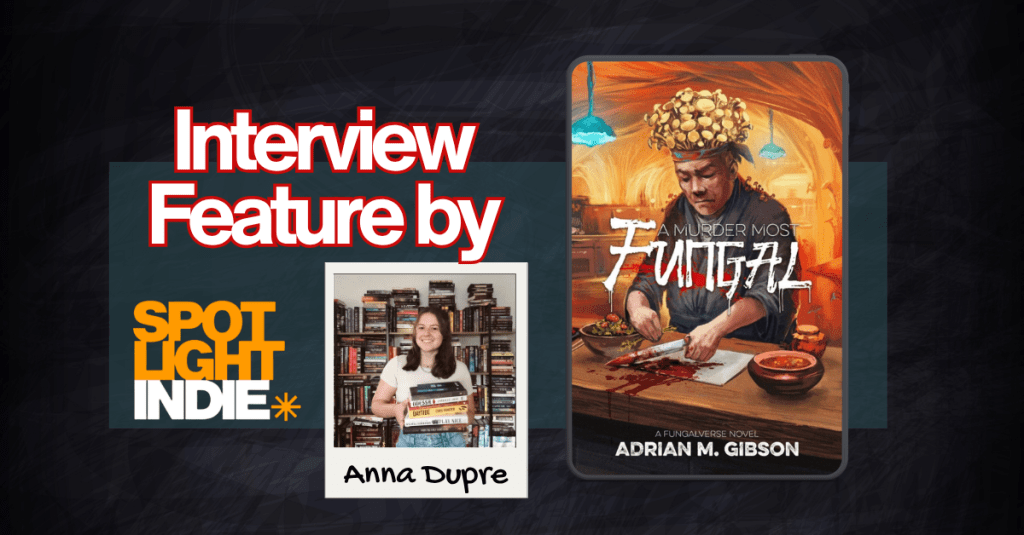
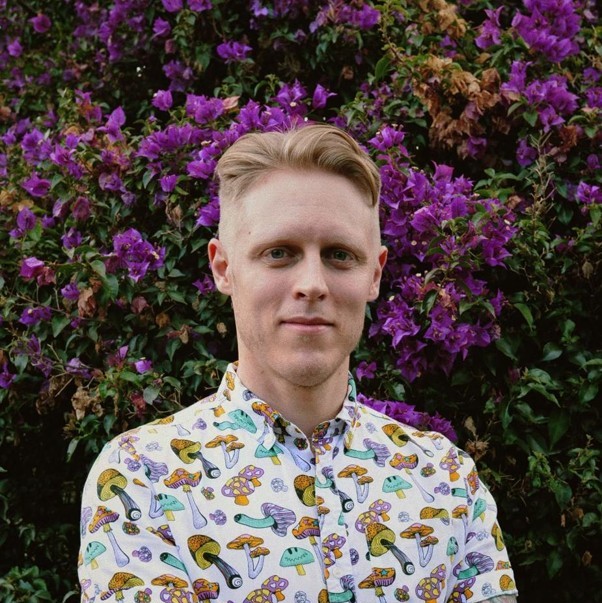
Fungalpunk is here to stay! One of the pioneers of its modern movement is the legend that is Adrian M. Gibson. In 2025, he gave us Mushroom Blues, a *chef’s kiss* blend of detective noir and mushroomy fiction, set in a world where fungal people and humans are occupying the same city. Now, he’s returning to Neo Kinoko with his latest — A Murder Most Fungal.
1) Set in the same universe as Mushroom Blues, how did it feel to return to the world you crafted with A Murder Most Fungal?
ADRIAN: It was honestly so refreshing to go back into The Fungalverse and the city of Neo Kinoko in a way that wasn’t a direct sequel to Mushroom Blues. There’s a lot of weight that comes with writing a follow-up in a series, with established characters and a huge set of baked-in expectations. So, with A Murder Most Fungal being a standalone set between books one and two (essentially The Hofmann Report #1.5), there was a lot less pressure, while also allowing me to mix in new genres and explore the world—the fungal people especially—more in-depth without needing to cater directly to the needs of the overarching series.
2) World-building is a huge pillar of this series as made evident by the language, terminology, and unique working of these characters’ daily lives – how did you approach such expansive world-building in a way that was successful?
ADRIAN: For me, it’s always about focusing on more ordinary characters, in the sense that these aren’t kings and queens, nobles and highborns—I tend to gravitate towards middle- and lower-class people, like cops and chefs and gangsters and artists. In my opinion, those low-to-the-ground kinds of perspectives allow for many more worldbuilding opportunities, which I do my best to infuse and sprinkle in throughout the story. Their daily lives are what give the context for the world, and through their actions and conversations, their struggles and successes, the world gets more fleshed out. The expansiveness is exponential, in my mind.
3) A Murder Most Fungal is dedicated to Anthony Bourdain, one of the revered travelers and chefs of our lifetime. Can you unpack your inspiration from Bourdain and how his life’s work impacted the drafting of this novel?
ADRIAN: There’s so much I have to thank Tony for, but there’s one thing I can focus on. And while it was a slow influence over many, many years, I can see the direct impact it had on A Murder Most Fungal—that being the ethos of his excellent show Parts Unknown: venturing into unknown places and using food as the gateway to better understand that place, its culture, its people and more. There was always a rawness to Bourdain productions, and I was so inspired by how he’d step outside of his comfort zone, using food to bridge the gap between himself and the strangers around him. But those strangers didn’t remain strangers for long. Tony had the uncanny ability to tap into the beating heart of a place, and I’ve done my best to adopt that mentality everywhere I’ve lived and traveled. From growing up in Canada to living abroad in Germany and Ecuador, and the dozens of countries I’ve visited over the course of my life, food has always been my go-to form of communication, even when I don’t speak the same language as someone else.
So, when it came to A Murder Most Fungal, I applied the “Tony Mindset” to my worldbuilding, trying to understand the framework of cuisine within the fungal culture, such that I could connect the dots in the complex web of things food affects and reveals: cultural cues, the very biology of the fungal people, social hierarchies, religion, geography, forms of communication, access to resources and viable land, family structures, institutions of power—the list goes on. I came to understand this fictional race that I created on a much deeper level because of this approach, because I was able to utilize food to unlock the fundamental truths of the mushroom people. And that resulted in a much stronger story, more believable characters, and a richer, more textured world.
After all, food is a window into the heart and soul of a person and a place, and nobody did that better than Bourdain. Here’s hoping I did him justice in A Murder Most Fungal.
4) Within the first few chapters of reading A Murder Most Fungal, I was absolutely starving – the way you write about food is tactile and enticing beyond belief. How did you draft this novel without eating variants of the dishes described the whole entire time?
ADRIAN: Thank you so much! I put a lot of effort into making the descriptions of food evoke these kinds of reactions without getting bogged down in every flavor or texture or smell or ingredient. And the reality is, I did make and eat a lot of these dishes (or real-world variants of them ha ha). But trust me, there were plenty of chapters where I would literally be salivating while writing or editing. My hope is that readers are just as hungry after reading!
5) And as a follow up to the previous question, I would love to hear about your creative process in writing these dishes – the mindset, research, or other work needed to bring this food to life on the page.
ADRIAN: So as I mentioned, I actually cooked a lot of the dishes in the book, so I had a familiarity with them on a personal level. Some are even variations on recipes that I’ve workshopped myself over years and years. As well, I’ve worked in restaurants and kitchens, so I know the vibe, the flow and the mindset of that kind of professional setting (as well as the chaos that is common in a high-stress environment like that). But I also cook every day for my family, almost like using nourishment as a love language—it’s such a fundamental part of my life and I absolutely adore food on every level.
But my main character, Pocho Jiro, is a sushi chef, and I’m not a sushi chef. So, there was quite a lot of research that went into the specifics of sushi: how to get the perfect rice, knifework and the right types of knives, the particulars of seafood (freshness, handling, avoiding contamination, etc.), and so on and so on. Which is why I’m so lucky that one of my best friends was a sushi chef for multiple years, so he became my personal sounding board and “sushi encyclopedia.” He taught me so much, and a lot of that was directly infused into Pocho, as well as the other chefs in his kitchen.
The challenge then was how to translate a) the creation/consumption of dishes and b) the full sensory experience onto the page. I can credit the Pixar film Ratatouille for inspiring me on that front, because visual, audible and textual language can actually achieve so much to evoke sensations within the human mind. As such, I knew I had to invoke all the senses as often as I could, so that you could taste, feel, smell, touch and hear these dishes. I was also very thoughtful about finding the right balance between describing the dishes and making you salivate with maintaining the appropriate story flow and pacing. A lot of that came down to ACTION, in the sense that the food was always paired with a character actively doing something else at the same time as cooking or eating; it’s like the layering of a cake, and there is a multi-layered purpose to every moment beyond just, “Hey! This sounds delicious, doesn’t it?”
6) How would you compare the tone of Mushroom Blues to A Murder Most Fungal? What can readers expect with this entry into the Fungalverse?
ADRIAN: The tone is quite different, and even a fair bit darker in some respects. Whereas Mushroom Blues was a murder mystery/police procedural, A Murder Most Fungal is a piece of sushi, with a crime thriller filling and culinary aspects and interpersonal drama wrapped around it like rice and seaweed.
There is more of a tonal balance in this book though. On one hand, there’s an underlying sense of darkness permeating the world and the tragic downfall of Pocho Jiro, and on the other that darkness is alleviated by the captivating wonders of cooking, a multitude of sensory experiences and heartfelt moments between characters. My aim is to give readers a very personal, tragic character study of this obsessive chef, his life falling apart as a result of fungal gangsters blackmailing him into committing a murder with his own food. But also, to balance the scales with moments of genuine friendship, love, connection and community.
7) Now, this question feels a tad silly, BUT logistically, A Murder Most Fungal features a Hōpponese chef, Pocho, who cooks and eats many things, some of which are indeed mushrooms. In the laws of the Fungalverse, would this not be considered cannibalism?
ADRIAN: Ha ha this is actually something I touched on in Mushroom Blues, but the fungal people view cannibalism differently than we do. Technically, YES, it is cannibalism, but only from a human perspective. For the fungals, eating a mushroom is part of a positive feedback loop and the cycle of life and death, where all fungi on the Hōpponese Archipelago are growing and feeding and decomposing into the greater whole. So, on a spiritual level, it’s kind of akin to the cycles of reincarnation in a religion like Hinduism. Therefore, the practice of a fungal eating a mushroom is not treated with disgust, but rather reverence, where one organism is merging into another organism. And ultimately, their spirits (and organic material) are feeding back into the natural world and the larger fungal network/system that sustains the whole race.
8) What other pieces of media or art did you reference when writing A Murder Most Fungal?
ADRIAN: Soooo much. The films of Martin Scorsese, food shows and documentaries (I already spoke about Bourdain, but Jiro Dreams of Sushi was one of the touchstone inspirations/references), as well as Ratatouille, one of my all-time favorite movies and a pillar of animated excellence. There was also a lot of inspiration taken from Hong Kong action movies and crime thrillers, like A Better Tomorrow, Hard Boiled, Police Story, Infernal Affairs and many more. They helped a lot to inform my approach for the thriller and criminal aspects of the story. Speaking of which…
9) While a lot of my previous questions have centered around the culinary nature of this novel, there is a very tense situation unfolding that involved many moving set pieces of blackmail, espionage, and politics. How did you juggle these very intense themes while also depicting culinary skills as an art form?
ADRIAN: I think a lot of it ties back to the tonal balance I mentioned earlier. Because I love thrillers and appreciate what they can offer on a story structure level, which made the flow of the book more clear, and allowed me opportunities to decide, “Okay, we just had a pretty intense scene about gangsters and blackmail, so I’m going to have this next chapter be a scene between Pocho and his sister, or a cooking-centric scene in the kitchen.” And that’s not to say the intense and calm aspects don’t connect—they’re deeply intertwined, and the stakes are an ever-present threat that keeps the story momentum moving. The important thing for me was to treat this story like a roller coaster, giving readers moments of high and low intensity, controlling the emotional weight and tension for different purposes.
Another trick I used was having “palate cleanser” interludes, which appear at the end of each of the five parts of the story. These interludes are flashbacks into Pocho’s past, showing moments that give insight into how he became the chef that he is in the present. What it also does is solidifies how cuisine is both a craft and an art form and something that this character has passionately dedicated himself to and worked to perfect over the course of his entire life.
10) What are you most looking forward to with the release of A Murder Most Fungal?
ADRIAN: I’m excited for people to return to Neo Kinoko and see it from a new angle, especially with a fungal point-of-view character. But I’ll be most curious to see how people connect with Pocho and the fact that he’s both a strange, mushroom-human hybrid, but also that he’s deeply embroiled in relatable, everyday problems (as well as not so everyday problems like being blackmailed into murdering someone).
11) Can you talk about your future plans for the Fungalverse and what readers can expect next?
ADRIAN: There’s a lot coming that I know people are going to be excited about, including projects in mediums beyond just books. But that’s all hush-hush for the time being. As well, the second book in The Hofmann Report series is in the works, so readers can look forward to that in 2027!
12) If you could give any read-a-likes or watch-a-likes for folks who are looking to prepare for reading A Murder Most Fungal, what would you recommend?
ADRIAN: For books, I would say check out Seven Recipes for Revolution (it features a butcher protagonist), The Tainted Cup by Robert Jackson Bennett (it’s got a ton of weird and wonderful worldbuilding) and Kitchen Confidential by Anthony Bourdain (which is one of the best “inside looks” into restaurant/chef life I’ve ever read). And then on the TV and film side, below is a list of recommendations that directly inspired my novel:
- The Bear (TV show)
- Anthony Bourdain: Parts Unknown (TV show)
- Anthony Bourdain: No Reservations (TV show)
- Jiro Dreams of Sushi (documentary)
- Ratatouille (movie)
- A Better Tomorrow (movie)
- Hard Boiled (movie)
- The Departed (movie)
- Goodfellas (movie)
- Casino (movie)
- The Aviator (movie)
- Gordon Ramsay: Uncharted (TV show)
- Chef’s Table (docuseries)
- Ugly Delicious (TV show)
- Kitchen Nightmares (TV show)
- The Chef Show (TV show)
A Murder Most Fungal will be released on June 16th and is available for pre-order now!
Pre-Order eBook: https://www.amazon.com/dp/B0GSW6DKM4
Pre-Order Signed/Numbered Hardcovers: https://www.thebrokenbinding.co.uk/product-page/a-murder-most-fungal-numbered-adrian-m-gibson
Pre-Order The Hofmann Report 2-Book Bundle:
https://www.thebrokenbinding.co.uk/product-page/the-hofmann-report-2-pack-adrian-m-gibson
Adrian’s Website: https://www.adrianmgibson.com
Follow Adrian on all the socials using @adrianmgibson



Leave a Reply