
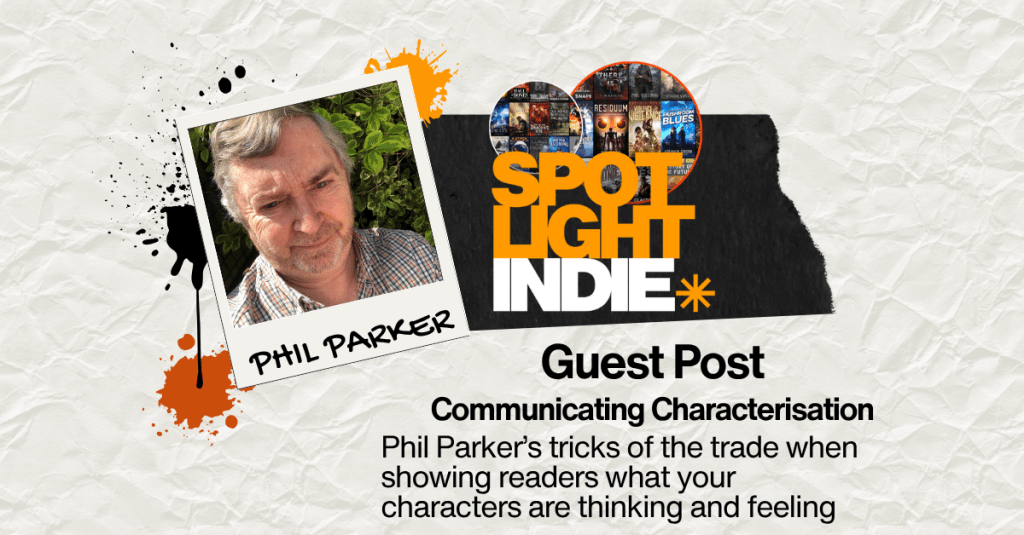
As writers we often hear the mantra, “Show, don’t tell.” It’s good advice but finding effective forms of illustration isn’t always easy, especially where characterisation is concerned. So much of our “reading” of human behaviour is witnessed via non-verbal cues. You might be familiar with the 55/38/7 model, developed by the American psychologist, Albert Mehrabian. His research found we discern 55% of signals from someone’s body language, 38% through their tone of voice and just 7% from what they actually say.
We judge by what we see and the subtle ways in which our voices betray our thinking and feelings. As we grow into adulthood, we become more adept at reading these signals, as well as misinterpreting them sometimes too. For the writer, it is quite a challenge to turn these signals into words and explain them in different and original ways. It’s tempting to get out the thesaurus to find different ways of using “said”, isn’t it? The fact remains, it’s not what is said, it’s how it’s shown.
For a long period of time (which I’m not disclosing here!) I taught Drama to 11-18 year-old students. The work included directing plays and getting the best out of my young performers. The theory behind this work has stood me in good stead as a writer because it means doing the same thing – communicating characterisations to an audience. A starting point for students has always been for them to create a character and then challenge them with this question: how will anyone watching you know those things?
As a writer, you have to do the same thing. Like any actor, you can’t stand on stage and tell the audience what you’re doing (OK, Bertolt Brecht encouraged it!), you must find inventive ways to show them. The more effective you are in that display, the more credible you appear and, if you’re really good, the more engaging you are to the audience. That’s the challenge for the writer too.
So, how to make your characters appear credible and engaging to your readers? The answer lies in communicating what you see – and this falls into three categories.
Body Language
I mentioned earlier how 55% of all non-verbal communication is displayed this way. Here are just a few suggestions to get you started:
Stance – whether upright or stooped shows age, stress levels, exhaustion; the shoulders are an excellent indicator to this end. Folded arms is a sign of resentment. Hands on hips shows antagonism. Chest out, shoulders back = aggression. Lowered head, looking upwards is for timidity.
Movement – describe how the character walks; a strut shows confidence, if they march it conveys determination, uncertainty and exhaustion gets a shuffle. The speed of movement also conveys meaning – from urgency and anxiety when its fast; deliberation, satisfaction when it’s slow.
Gesture is always useful. Some people gesture a lot, conveying open and even flamboyant communication, the hands are vital here. Beyond that, traditional gestures let you show meaning without words – the surrender gesture of raised palms, raking hair with fingers to show nervousness, covering the mouth indicates regret or awkwardness. We instantly recognise what these gestures mean but targeted use can tell us more about the character. Just make sure those gestures are consistently used to convey key qualities.
The face is the most expressive of all. There are over forty muscles in the face, enabling a wide range of expression. It’s worth having a mirror handy to help you decide what your characters are feeling. Muscles around the eyes do a lot of work; narrowing the eyes shows suspicion, determination, widening them highlights shock. Above the eyes, knitted eyebrows can show confusion or concern, frown lines on the forehead vary in depth to convey degrees of emotion. The mouth is flexible too, a pout sends one message, a nibbled bottom lip something else, the set out of the mouth itself something else again. Don’t forget how it makes the chin work as well, the set of the jaw (even grinding of the teeth) displays determination and even anger.
The Voice
38% of non-verbal communication is defined by the quality of the voice – NOT the words spoken please note. A great exercise for actors is to make the voice convey different meanings using letter sounds (“Mmm”) only. How would you show anger compared to indecision with that sound? I used to get my students to remember the basics with PPV – Pitch, Pace and Volume.
Pitch is all about the tone of the voice. Higher pitches may convey weakness because they hint at immaturity. As a teacher, you’re told to lower your tone to convey authority (Margaret Thatcher altered her tone for that reason). Think about comparisons to enhance the tone’s description – a high-pitched tone might sound like the twittering of newly fledged birds for instance. A lower tone, that comes from deep in the chest, might be like an animal growling. An original and precise comparison is a great way to engage your reader and impress them with the quality of your writing!
Pace defines the speed of delivery of what is said. When someone gabbles, chances are they are nervous; a slow, deliberate delivery might show authority or insistence. A good speaker will also select key words to emphasise by changing… the pace. (See what I did there?) A useful tip – record dialogue from your story and play it back, then find other ways of delivering the same material. Which sounds best? Pace tells us a great deal but we don’t use it as much as we should.
Volume is obvious. We shout when we’re angry, we whisper when we’re uncertain or scared. Twin volume with pitch to get some useful variations.
Relationships
I’m keeping this section short because the variations are exponential! What I will say is this: that 93% of non-verbal communication varies, depending upon who is involved in the communication. For example – “I don’t know.” How would you deliver those words to your partner in an argument? How would it vary in a moment of tenderness? Now think, how would you say it to your boss when something’s not been explained clearly? How would you say it to a friend who wants you to commit to something you don’t want to do?
See what I mean? As a writer, it’s vital to consider the relationship being shown in that moment. Yes, THAT moment. Because, as character arcs develop, the same line might be delivered differently at another point in the story. Non-verbal signals are a wonderful way to show a relationship and how it develops over time – all without ever telling your reader anything!
Conclusion
Writers don’t just put words on the page, they are storytellers. Since the beginning of time, the best storytellers are those who give performances, hooking their audiences with the use of voice, face, body language and movement. The same truth remains but needs to be written into the storytelling by careful analysis of the non-verbal communication being used. As I always encouraged my students, a mirror and a recording device are helpful aids to this end.
Let me finish with a brilliant quote. Anton Chekhov had a profound impact on theatre and acting. A-Level students study him for that reason and it lies in this quote, which is equally as relevant to writers as actors: “In displaying the psychology of your characters, minute particulars are essential. God save us from vague generalisations!”

 Spotlight Indie
Leave a comment