
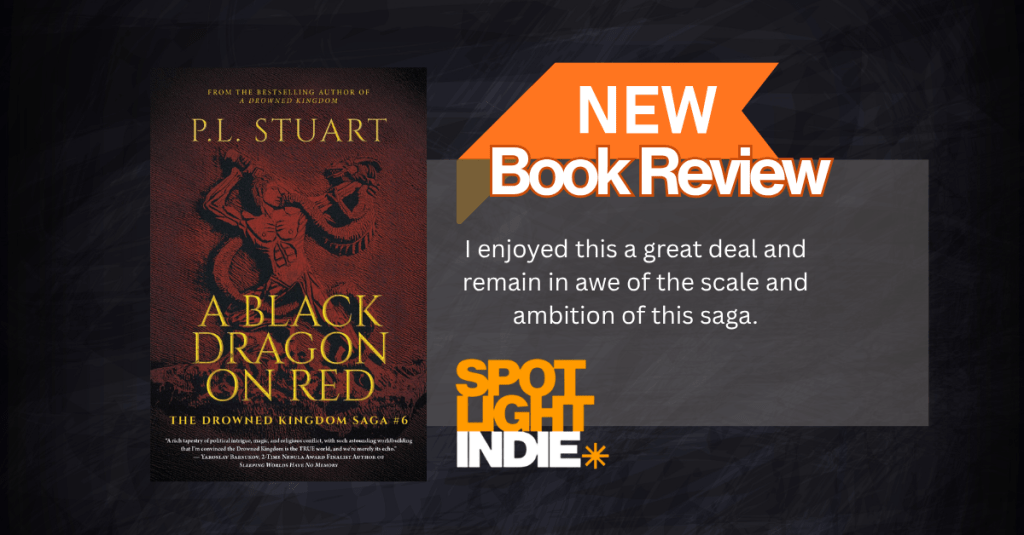
I’ve eagerly looked forward to each instalment of PL Stuart’s A Drowned Kingdom Saga since this series first began in 2021. Every year Stuart produces another book in a pleasingly reliable fashion, and with A Black Dragon on Red we reach the sixth novel in his planned seven-book series. Please note this review does contain some spoilers regarding the ending of the previous book. It’s been a wild ride so far, Stuart ably weaving together a complex historical narrative of how culture and religious beliefs survive and adapt in a new land alongside magic, fallen angels, and a fateful prophecy concerning the end of the world.
All this means the stakes are high going into A Black Dragon on Red, especially after the compelling and tragic events in the fifth book, A Pack of Wolves, which had been my favourite novel in the series so far. No stranger to a dramatic opening, Stuart delivers another gripping prologue in this novel, taking the reader back in time to a period early in Eltnia’s history. The Anib have long departed Acremia for their homeland but the people of Eltnia still remember their legacy as new kingdoms rise to take their place.
Although Stuart has played with time before in this series, what surprised me was his decision in this book to stay with events in the distant past not just for Part I of the novel but also for Part II as well. Every novel in the series is told in three parts and A Black Dragon on Red follows this pattern. We don’t return to the timeline of A Pack of Wolves until 70% in, when Part III begins, whilst Othrun doesn’t even make an appearance until 74% of the way through the novel.
Instead, we’re taken back in time hundreds of years and follow events concerning a whole group of new characters for the majority of this book. Stuart has not been afraid to take risks throughout this saga, but this is a big one in the sixth book of an ongoing series, since you lose so much shorthand when you move away from the established cast. As a result, it takes some time to become invested in this new storyline, especially since not all the new characters Stuart introduces survive.
I don’t want to spoil the story, so I’m going to refrain from explaining who these characters are. What I can say is that, as the tale unfolds, the reader gradually gets a much wider understanding of the context of events in the first five books of the series. In that regard we follow an established pattern, where each book has gradually drawn back the curtain, revealing more each time. Now Stuart tears it down completely.
These narrative choices do mean Parts I and II are a bit uneven, with some exciting scenes weighed down by a lot of exposition. Stuart has to cover an enormous amount of ground spanning hundreds of years with a relatively small cast, and at times the information is conveyed through extended passages of dialogue which become rather dense and convoluted. The result is there’s an overwhelming onslaught of information in Parts I and II. Part of me, as the reader, wishes that Stuart had weaved more of this into the earlier novels in the series. However, had he done so we would have missed the huge payoff in this novel, with the heightened impact of those revelations, as the reader gains a proper understanding of Othrun’s true position and who his real enemies are.
If Parts I and II are all exposition, then Part III confounds the reader once more as the concluding act races along, the plot unfolding so rapidly it can be hard to keep up. As a man of action, Othrun is usually at his best in a time of crisis. Yet when Othrun finally appears we meet a drunkard, fallen low from his high standing and proud bearing, a shadow of the man who first landed on Acremia’s shores, leading the last of the Atalanteans. His second son Arclan is now the First Prince, destined to rule after Othrun the Younger was killed in battle. This becomes a tale of painful, broken relationships since Othrun the Younger’s death casts a long shadow. The gulf between Othrun and his wife, Sila, showing how love can sour in the face of tragedy and perceived betrayal is particularly well-written.
Overall, this is a difficult book to review. After struggling with Parts I and II, I enjoyed Part III the most, mainly because we return to characters I’ve grown to know so well over the years. Stuart really kept me guessing about where the story was going as well, which is no mean feat when you’re six novels deep into a saga. The ending is so shocking and unexpected, with a thrilling climax featuring one of the best-written battle scenes I’ve ever read. Although A Pack of Wolves remains my favourite book in this series thus far, Part III of A Black Dragon on Red features some of Stuart’s best writing.
Sometimes the flaws in a gem are what give it character, somehow increasing its appeal in the eye of the beholder. That’s how I feel after reading this book. Whilst not perfect, I enjoyed this a great deal and remain in awe of the scale and ambition of this saga. Of course Stuart has left the biggest question of all unanswered. Who is the Black Dragon? We now have to wait until the seventh and final novel, Sure-Steel, is released in 2027 so we can find out.
I was kindly sent an advance copy by the author in exchange for a fair and honest review.



 Spotlight Indie
Leave a comment